 SHOP MOST POPULAR
 MIXOLOGY KITS
 BESPOKE BITES
 BARWARE
 SPIRITS
 CORPORATE EVENTS
Gifting has never been easier
Perfect if you're short on time or are unable to deliver your gift yourself. Enter your message and select when to send it.

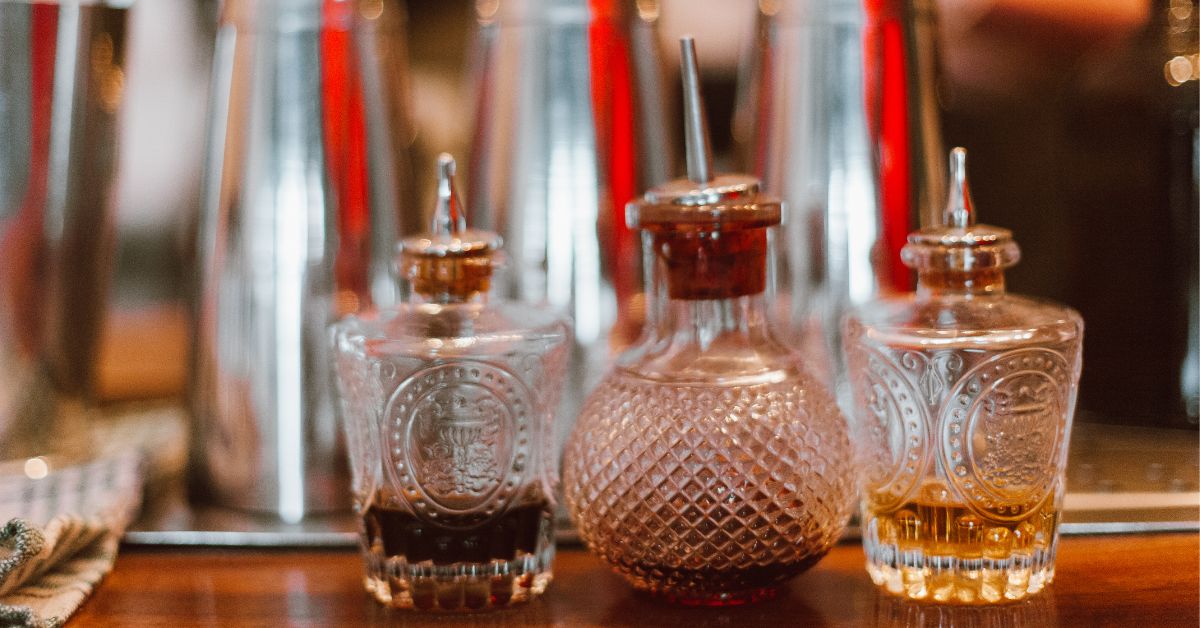

Cocktail bitters are one of the most common ingredients in classic cocktail recipes and one of the least understood. Most people who follow a recipe that calls for “two dashes of Angostura” add them without knowing what they’re actually doing to the drink.
Cocktail bitters are concentrated herbal extracts made by infusing botanicals, herbs, spices, roots, bark, and citrus peels, into high-proof alcohol. Used in small amounts, typically two to three dashes, they add aromatic complexity, depth, and structure to a cocktail without contributing noticeable flavor of their own. They’re not there to taste like anything in particular. They’re there to make everything else taste better.
This guide covers what bitters are, where they came from, the most common types, and how to use them correctly.

Bitters weren’t invented for cocktails. In the early 1800s, they were sold as medicinal tonics, concentrated botanical extracts believed to support digestion, settle the stomach, and treat a range of ailments. Angostura bitters, still the most widely used aromatic bitters today, were created in 1824 by a German physician named Johann Gottlieb Benjamin Siegert while serving as Surgeon General in Venezuela. He named them after the town of Angostura, now called Ciudad Bolívar.
Their migration from medicine cabinet to bar happened gradually. By 1806, one of the earliest published definitions of a “cocktail” already included bitters alongside spirit, sugar, and water, the same four-element structure that became the Old Fashioned. As cocktail culture developed through the 19th century, bitters became a standard tool behind the bar, less for their supposed medicinal properties and more for what they did to a drink’s flavor.
Today, cocktail bitters are available in a wide range of styles. Classic options like aromatic and orange bitters remain the most widely used, but more modern variations include flavors like chocolate, coffee, lavender, and even walnut. Each one brings a slightly different character, but the role stays the same.
The bottles look different and there are far more varieties today, but bitters still serve the same function they did in 1824.
Most cocktail recipes call for just a few dashes of bitters, often two or three at most, It’s easy to assume they’re a minor detail.
In a spirit-forward cocktail, though, bitters do real structural work. They add aromatic complexity, a dry, herbal, spiced layer that gives the drink depth without contributing a flavor that competes with the spirit. The sweetness from the syrup feels more refined with bitters present. The whiskey feels more integrated. The finish lingers longer and feels more complete.
The clearest way to understand what bitters contribute is to make the same cocktail without them. An Old Fashioned without bitters is sweetened whiskey, not bad, but one-dimensional. With two dashes of Angostura, it becomes a cocktail. The bitters don’t announce themselves, but their absence is immediately noticeable.
That’s what makes them easy to underestimate. They work quietly, shaping the drink from the background rather than the foreground.

| Bitters | Flavor Profile | Classic Use Cases |
|---|---|---|
| Angostura Aromatic | Clove, cinnamon, spice, herbal | Old Fashioned, Manhattan, Champagne cocktail |
| Peychaud’s Aromatic | Lighter, floral, anise-forward | Sazerac, Vieux Carré |
| Orange Bitters | Bright citrus, slightly bitter | Martini, Manhattan, Negroni |
| Mole / Chocolate Bitters | Dark chocolate, spice | Mezcal cocktails, dark spirit builds |
| Cardamom Bitters | Floral, slightly sweet spice | Modern builds, gin cocktails |
| Coffee Bitters | Roasted, slightly bitter | Espresso Martini variations, whiskey cocktails |
Angostura is the default, the bitters most recipes mean when they just say “bitters.” Its flavor is complex and warm: clove-forward, with cinnamon, gentian root, and a range of other botanicals that give it a distinct spiced character. In an Old Fashioned or Manhattan, it adds depth and a dry finish that pulls the drink together.
The bottle is recognizable by its oversized paper label, which is intentional, legend holds that when the Siegert brothers entered Angostura into a competition in 1862, they forgot to source a properly sized label and used what they had. They won the competition, and the oversized label became part of the brand identity.
Peychaud’s is lighter and more floral than Angostura, with a prominent anise note. It’s the bitters of choice for a Sazerac and plays a key role in several New Orleans classics. In an Old Fashioned, some bartenders use a combination of Angostura and Peychaud’s — the Angostura for structure, the Peychaud’s for a floral lift.
Orange bitters were actually more common than aromatic bitters in the late 19th century before largely disappearing for most of the 20th. They’ve since come back into wide use. Regans’ Orange Bitters No. 6 and Fee Brothers West Indian Orange Bitters are two of the most common. In a Manhattan or a Martini, orange bitters add a bright citrus note that lifts the drink without adding sweetness.
The standard for most cocktail recipes is 2 dashes. A dash from a dasher-top bottle is roughly 0.6 ml, so two dashes amounts to just over a milliliter. That’s intentionally small, bitters at full concentration are intensely flavored, and the goal is influence, not presence.
Starting with 2 dashes and adjusting from there is the right approach. Some drinkers prefer 3 dashes of Angostura in an Old Fashioned for a slightly more pronounced spice note. Going beyond that tends to tip the drink into bitterness that competes with the spirit.

In a built cocktail like an Old Fashioned, bitters go in first, before the sweetener and before the whiskey. Adding them directly to the glass lets them coat the bottom before the other ingredients are poured over, which helps them distribute evenly through the drink during stirring.
In shaken cocktails, the order matters less since shaking distributes everything evenly. But bitters are still added before the ice, along with the other ingredients.
Bitters have a very high alcohol content, typically 35–45% ABV, which acts as a natural preservative. An opened bottle keeps essentially indefinitely at room temperature, away from direct sunlight. There’s no need to refrigerate them.
Bitters appear in a wide range of classic cocktails, but they’re most prominent (and most important) in spirit-forward drinks with minimal ingredients. The Old Fashioned, Manhattan, Sazerac, and Vieux Carré all depend on bitters to provide the aromatic structure that keeps the drink from feeling flat.
In longer, more citrus-driven cocktails, a Gin & Tonic, a Mojito, a Daiquiri, bitters are sometimes used, but they’re less essential. The citrus and other ingredients provide enough complexity on their own that bitters become more of a finishing touch than a structural element.
The principle is similar to demerara syrup: the simpler and more spirit-forward the cocktail, the more noticeable and important the bitters become.
On their own, bitters taste intensely herbal, bitter, and aromatic, they’re not pleasant to drink straight. But in a cocktail at 2 dashes, that intensity translates to depth and complexity rather than bitterness. Angostura specifically tastes of clove, cinnamon, and warm spice. Orange bitters taste of concentrated citrus peel with a dry finish.
Yes. Most cocktail bitters are 35–45% ABV, similar to many spirits. Because only a few dashes are used per drink, the amount of alcohol they contribute is negligible — roughly equivalent to adding a few drops of water.
Angostura is heavier and more complex, with a prominent clove and spice character. Peychaud’s is lighter and more floral, with a noticeable anise note. Angostura is the more versatile of the two and works in a wider range of cocktails. Peychaud’s is particularly associated with New Orleans classics like the Sazerac.
Technically yes, but it changes the drink significantly. Without bitters, an Old Fashioned is sweetened whiskey with a citrus garnish — it lacks the aromatic structure and dry finish that bitters provide. Most bartenders would consider the result incomplete. The bitters are part of what makes it a cocktail rather than just a sweetened spirit.
They overlap but aren’t identical. Cocktail bitters and digestive bitters (like Campari or Aperol) are both botanical extracts, but digestive bitters are meant to be consumed in larger amounts, as an aperitif or digestif, and are significantly less concentrated. Cocktail bitters are used only a few dashes at a time because of how concentrated they are.
Bitters are the smallest ingredient in most cocktail recipes and the easiest to underestimate. Two dashes doesn’t look like much. But in a spirit-forward drink with four ingredients, that small amount does real work, adding the aromatic complexity and dry structure that keeps the drink from falling flat.
The Mixologer’s Old Fashioned cocktail kits include Angostura bitters pre-measured alongside the whiskey and demerara syrup, so every element is already in the right proportion. The structure is built in from the start.