 SHOP MOST POPULAR
 MIXOLOGY KITS
 BESPOKE BITES
 BARWARE
 SPIRITS
 CORPORATE EVENTS
Gifting has never been easier
Perfect if you're short on time or are unable to deliver your gift yourself. Enter your message and select when to send it.

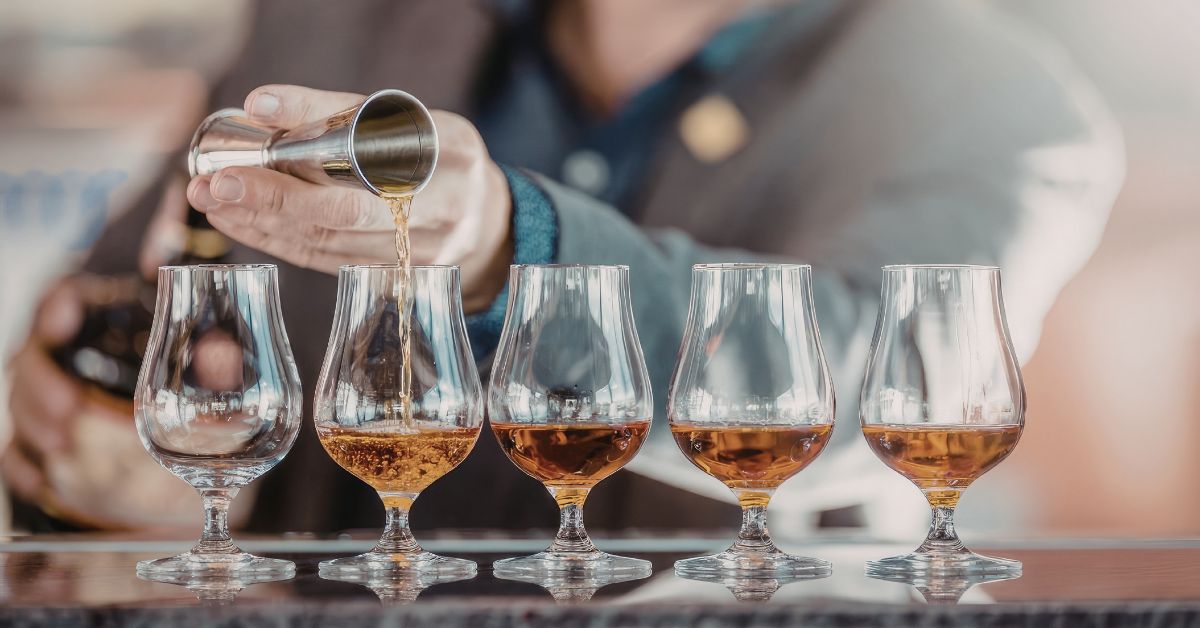

There are four types of whiskey most people encounter at a bar, bourbon, scotch, rye, and Irish, and they taste completely different from one another. The differences come down to three things: where it's made, what grains are used, and how it's aged. Once you understand those three variables, every whiskey starts to make sense.
All whiskey starts the same way: grain is fermented into a beer-like wash, distilled to increase the alcohol content, and then aged in oak barrels. That aging process is where most of the flavor comes from. The wood imparts vanilla, caramel, spice, and smoke, depending on how the barrel was treated and how long the spirit rested inside it.
The differences between types of whiskey come down to which grains are used, where it's made, and the production rules each style must follow.
Bourbon is a sweet, full-bodied American whiskey with notes of caramel, vanilla, and oak.
To legally be called bourbon, a whiskey must:
The high corn content is what gives bourbon its characteristic sweetness. The new charred oak requirement and no recycled barrels allowed, is why bourbon tends to be so rich in vanilla and caramel compared to other whiskeys.
Kentucky produces the vast majority of the world's bourbon (Maker's Mark, Wild Turkey, Woodford Reserve, Buffalo Trace), but bourbon can technically be made anywhere in the United States.
What it tastes like: Sweet up front, caramel, vanilla, sometimes a little dried fruit. Warmth through the middle. A long, slightly spicy finish that varies depending on the proof and the rye content in the mash bill.
Best for: An Old Fashioned, a Whiskey Sour, or just over a large ice cube.
Rye is an American whiskey made mostly from rye grain, drier, spicier, and more assertive than bourbon.
Like bourbon, rye whiskey must:
The shift from corn to rye changes everything about the flavor profile. Where bourbon leans sweet and mellow, rye leans dry and spicy, think black pepper, dried fruit, and baking spice. It's more aggressive, more complex, and holds up better when mixed with bold ingredients.
Rye whiskey was actually the dominant American whiskey style before Prohibition nearly wiped it out. It's had a major revival over the last decade, thanks in large part to the cocktail renaissance.
What it tastes like: Drier and more assertive than bourbon. Spice-forward, black pepper, cinnamon, sometimes a savory herbal edge. Less sweetness, more complexity.
Best for: A Manhattan or a Sazerac, cocktails where that punchy rye character is exactly what you want.

Scotch is a Scottish whisky (note the spelling, no "e") made primarily from malted barley, aged at least three years, and known for its depth and complexity, and in some regions, heavy smoke.
Scotch has strict rules too:
Scotch is the most regional of the major whisky styles. Where a bottle is from within Scotland tells you a lot about what it'll taste like.
The main Scotch regions:
What it tastes like: Highly variable by region. Generally more complex and drier than bourbon, with more obvious grain character and, depending on region, significant smoke.
Best for: Sipping neat or with a small splash of water, which opens up the aromatics considerably.

Irish whiskey is triple-distilled, made on the island of Ireland, and known for being exceptionally smooth and approachable, the easiest gateway into the whiskey world.
Irish whiskey rules:
The triple distillation process removes more of the harsher compounds, resulting in a cleaner, lighter spirit than most bourbon or Scotch. Irish whiskey rarely uses peated malt, which means it lacks the smokiness you find in Islay Scotch.
The big names like, Jameson, Redbreast, Tullamore D.E.W., Bushmills, represent a wide range from everyday sipper to serious collector bottle.
What it tastes like: Smooth, light, and approachable. Notes of green apple, honey, vanilla, and sometimes a gentle floral quality. Very little smoke.
Best for: On the rocks, with ginger beer (Irish Mule), or in a hot toddy.

| Bourbon | Rye | Scotch | Irish | |
|---|---|---|---|---|
| Country | USA | USA | Scotland | Ireland |
| Primary Grain | Corn (51%+) | Rye (51%+) | Malted barley | Barley (malted + unmalted) |
| Flavor Profile | Sweet, caramel, vanilla | Spicy, dry, peppery | Complex, earthy, sometimes smoky | Smooth, light, approachable |
| Aging Requirement | New charred oak | New charred oak | 3+ years in oak | 3+ years in oak |
| Smoke Level | None | None | Low to very high (region-dependent) | Usually none |
| Entry Point | Maker's Mark, Buffalo Trace | Rittenhouse, Bulleit Rye | Glenfiddich 12, Macallan 12 | Jameson, Redbreast 12 |
If you're new to whiskey: Start with Irish. The smoothness and approachability make it the lowest barrier to entry. Jameson on the rocks is a great first move.
If you want to make classic cocktails: Start with bourbon. An Old Fashioned or Whiskey Sour with a solid bourbon is where most people fall in love with the category.
If you already like bourbon and want more complexity: Try rye. A Manhattan made with rye instead of bourbon will show you exactly what the difference feels like in the glass.
If you want to explore something completely different: Try Scotch , start with a Speyside like Glenfiddich 12 before diving into peated Islay bottles.
No. Bourbon and scotch are two completely different whiskey styles. Bourbon is made in the United States from a corn-heavy mash bill and aged in new charred oak barrels. Scotch is made in Scotland from malted barley and aged in previously used oak casks. They share the same base category, whiskey, but share almost nothing else in terms of production or flavor.
The main difference is the primary grain. Bourbon must be at least 51% corn, which gives it a sweeter, fuller body. Rye must be at least 51% rye grain, which creates a drier, spicier, more assertive flavor. Both are made in the United States and aged in new charred oak barrels.
Scottish and Japanese producers traditionally spell it "whisky" (no e). American and Irish producers generally spell it "whiskey" (with an e). Both spellings refer to the same category of spirit, the difference is purely regional tradition and has no bearing on flavor or quality.
No. Irish whiskey is made in Ireland from a mix of malted and unmalted barley, typically triple-distilled for smoothness, and aged in used oak casks. Bourbon is made in the United States primarily from corn and aged in new charred oak barrels. They taste quite different, bourbon is richer and sweeter, Irish whiskey is lighter and smoother.
Single malt refers to a whisky made at a single distillery using 100% malted barley. It does not mean the bottle contains whisky from a single barrel, it can be blended from many barrels produced at that one distillery. Single malt Scotch is the most common use of the term, but single malt Irish whiskey and single malt American whiskey also exist.
Irish whiskey is generally the easiest starting point because of its smooth, light character. Jameson, Bushmills, or Tullamore D.E.W. are all approachable options. From there, a quality bourbon like Broken Boundaries or Buffalo Trace is the natural next step before venturing into rye or Scotch.
The four major types of whiskey, bourbon, rye, scotch, and Irish, each have their own rules, regions, and flavor identities. Bourbon is sweet and American. Rye is spicy and assertive. Scotch is complex, earthy, and sometimes smoky. Irish is smooth, light, and easy.
Start with the style that matches where you are right now, and don't be afraid to work through all four. Each one opens up a different side of what whiskey can be.
Want to start making great whiskey cocktails at home? Our Ultimate Old Fashioned Box comes with a premium bourbon chosen specifically for cocktails, everything you need, no guesswork required.