 SHOP MOST POPULAR
 MIXOLOGY KITS
 BARWARE
 SPIRITS
 CONTACT US
Gifting has never been easier
Perfect if you're short on time or are unable to deliver your gift yourself. Enter your message and select when to send it.



If you’ve come across demerara syrup in a cocktail recipe and weren’t sure what it was or whether it was worth tracking down, the short answer is: it’s worth it.
Demerara syrup is a liquid sweetener made from demerara sugar, a minimally refined raw cane sugar, dissolved in water. It’s richer and more complex than plain simple syrup, with a subtle molasses depth that integrates into spirit-forward cocktails in a way that regular sugar doesn’t. In a drink like an Old Fashioned, it’s often the detail that separates a cocktail that tastes fine from one that feels complete.
This guide covers what demerara syrup is, how it’s different from other sweeteners, how to make it at home, and when it’s worth using over simpler alternatives.

Demerara sugar is a raw cane sugar with large, golden-brown crystals and a natural molasses content that standard white sugar has had refined out of it. It originated in the Demerara region of what is now Guyana, though today it’s produced in several countries and widely available.
The key difference between demerara and white sugar is refinement. White sugar goes through a process that strips out nearly all of its natural molasses, leaving a clean, neutral sweetness. Demerara sugar skips much of that process, which preserves the molasses, and with it, a deeper, more rounded flavor that carries through into whatever you use it in.
When you dissolve demerara sugar into water to make a syrup, that character comes with it. The result is a sweetener with a warm, slightly complex flavor that does more than just add sweetness.

| Sweetener | Flavor Profile | Consistency in Drink | Best For |
|---|---|---|---|
| Sugar Cube | Neutral, lightly sweet | Can be uneven if not fully dissolved | Traditional preparations |
| Simple Syrup (1:1) | Clean, straightforward | Fully integrates, consistent | Highballs, sours, lighter cocktails |
| Demerara Syrup (2:1) | Richer, slightly molasses-forward, more depth | Fully integrates with added complexity | Old Fashioned, Manhattan, spirit-forward cocktails |
| Honey Syrup | Floral, distinctly flavored | Integrates well | Bees Knees, Gold Rush, whiskey sours |
The main practical difference between demerara syrup and simple syrup is flavor depth. Simple syrup adds sweetness cleanly and gets out of the way. Demerara syrup adds sweetness and a subtle warmth that supports the other ingredients, particularly in spirit-forward drinks where there aren’t many other flavors to fill that space.
The difference between demerara syrup and a sugar cube is more about consistency. A sugar cube doesn’t always fully dissolve during stirring, which can leave the sweetness uneven from one sip to the next. Demerara syrup integrates completely, so the flavor stays consistent throughout the drink.

In a drink like an Old Fashioned, sweetness does more than soften the alcohol, it shapes the texture and structure of the drink. That’s where demerara syrup earns its place.
A sugar cube can work, but it doesn’t always dissolve evenly, which can make the experience feel slightly inconsistent from sip to sip. Demerara syrup blends more fully into the drink, adding a gentle warmth and depth that softens the edges without flattening the flavor.
What sets it apart isn’t just sweetness, but how it supports everything around it. There’s a slight richness, a hint of molasses depth, and a more integrated finish that brings the drink into balance without drawing attention to itself.
The difference isn’t dramatic, but it becomes easy to notice once you know what to look for.
Demerara syrup is most worth using in spirit-forward cocktails where small details tend to have a greater impact and the sweetener is a primary flavor component, not just a background note. Old Fashioneds, Manhattans, and certain rum-based drinks all benefit from that added depth, especially when the goal is balance rather than just sweetness.
In lighter, more citrus-driven cocktails like a Gin & Tonic, a Mojito, or a Daiquiri, the added complexity of demerara can sometimes work against the drink. Those cocktails tend to benefit from a cleaner sweetener that doesn’t compete with the other flavors. Simple syrup is usually the better call there.
The general principle: the more spirit-forward the cocktail, the more demerara syrup adds. The lighter and more citrus-driven, the less noticeable the difference.
Demerara syrup is sweet with a subtle, warm depth — a hint of molasses and caramel that sets it apart from plain simple syrup. It’s not strongly flavored enough to taste distinctly of molasses in a cocktail, but it adds a roundness that a neutral sweetener doesn’t.
Yes, and it works fine as a substitute in most cocktails. The flavor will be slightly cleaner and less complex, and the texture will be thinner if you use a 1:1 simple syrup. In spirit-forward cocktails like an Old Fashioned, the difference is noticeable but not disqualifying, it’s still a good drink, just a slightly less layered one.
The standard cocktail ratio is 2:1, two parts demerara sugar to one part water. This produces a richer, slightly thicker syrup than a 1:1 ratio. For spirit-forward cocktails, 2:1 is the better choice.
No, though they’re related. Brown sugar is white sugar with molasses added back in after refining. Demerara sugar is a raw sugar that retains its natural molasses content without going through full refining. In practical terms, brown sugar produces a softer, more treacle-like syrup. Demerara is drier and slightly more complex. For cocktails, demerara is the better choice.
Yes. Turbinado and demerara are both minimally refined raw cane sugars and are interchangeable for cocktail syrups. Turbinado (sold as Sugar in the Raw) is slightly less molasses-forward than true demerara, but the difference in a finished cocktail is minimal.
Demerara syrup is a small upgrade with a noticeable impact, particularly in cocktails where the sweetener plays a real structural role. The extra step of making it at home takes about five minutes, and once you’ve used it in an Old Fashioned, it’s genuinely hard to go back to a sugar cube.
If you’d rather skip the prep entirely, The Mixologer’s Old Fashioned cocktail kits include demerara syrup pre-portioned alongside the whiskey and bitters, everything already balanced, ready to build.
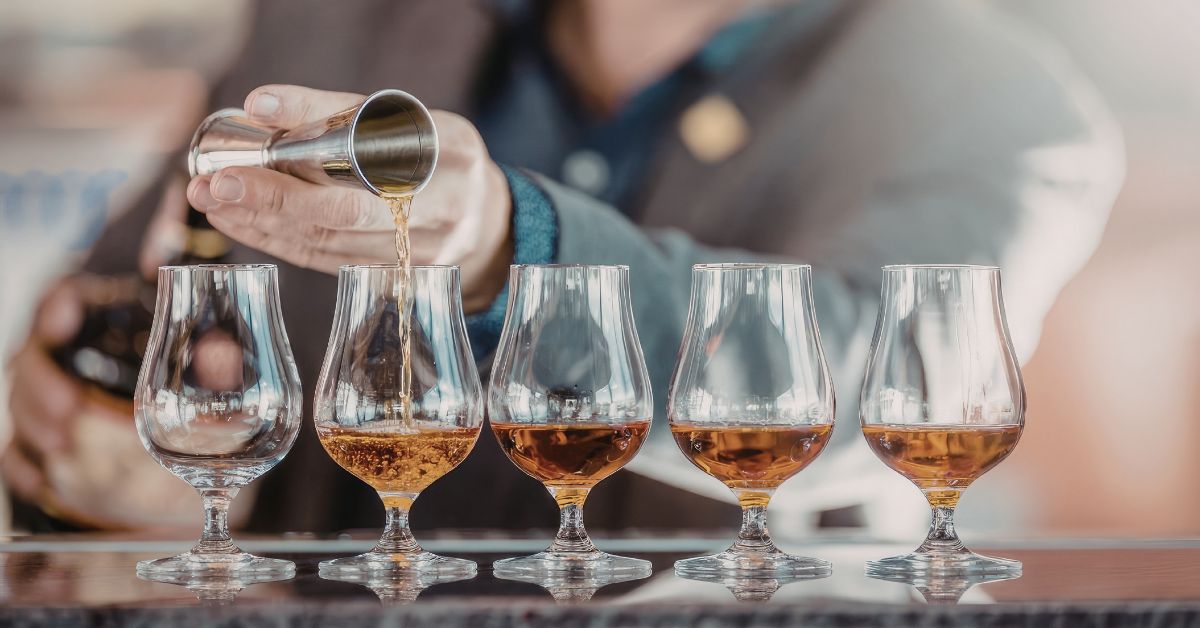

There are four types of whiskey most people encounter at a bar, bourbon, scotch, rye, and Irish, and they taste completely different from one another. The differences come down to three things: where it's made, what grains are used, and how it's aged. Once you understand those three variables, every whiskey starts to make sense.
All whiskey starts the same way: grain is fermented into a beer-like wash, distilled to increase the alcohol content, and then aged in oak barrels. That aging process is where most of the flavor comes from. The wood imparts vanilla, caramel, spice, and smoke, depending on how the barrel was treated and how long the spirit rested inside it.
The differences between types of whiskey come down to which grains are used, where it's made, and the production rules each style must follow.
Bourbon is a sweet, full-bodied American whiskey with notes of caramel, vanilla, and oak.
To legally be called bourbon, a whiskey must:
The high corn content is what gives bourbon its characteristic sweetness. The new charred oak requirement and no recycled barrels allowed, is why bourbon tends to be so rich in vanilla and caramel compared to other whiskeys.
Kentucky produces the vast majority of the world's bourbon (Maker's Mark, Wild Turkey, Woodford Reserve, Buffalo Trace), but bourbon can technically be made anywhere in the United States.
What it tastes like: Sweet up front, caramel, vanilla, sometimes a little dried fruit. Warmth through the middle. A long, slightly spicy finish that varies depending on the proof and the rye content in the mash bill.
Best for: An Old Fashioned, a Whiskey Sour, or just over a large ice cube.
Rye is an American whiskey made mostly from rye grain, drier, spicier, and more assertive than bourbon.
Like bourbon, rye whiskey must:
The shift from corn to rye changes everything about the flavor profile. Where bourbon leans sweet and mellow, rye leans dry and spicy, think black pepper, dried fruit, and baking spice. It's more aggressive, more complex, and holds up better when mixed with bold ingredients.
Rye whiskey was actually the dominant American whiskey style before Prohibition nearly wiped it out. It's had a major revival over the last decade, thanks in large part to the cocktail renaissance.
What it tastes like: Drier and more assertive than bourbon. Spice-forward, black pepper, cinnamon, sometimes a savory herbal edge. Less sweetness, more complexity.
Best for: A Manhattan or a Sazerac, cocktails where that punchy rye character is exactly what you want.

Scotch is a Scottish whisky (note the spelling, no "e") made primarily from malted barley, aged at least three years, and known for its depth and complexity, and in some regions, heavy smoke.
Scotch has strict rules too:
Scotch is the most regional of the major whisky styles. Where a bottle is from within Scotland tells you a lot about what it'll taste like.
The main Scotch regions:
What it tastes like: Highly variable by region. Generally more complex and drier than bourbon, with more obvious grain character and, depending on region, significant smoke.
Best for: Sipping neat or with a small splash of water, which opens up the aromatics considerably.

Irish whiskey is triple-distilled, made on the island of Ireland, and known for being exceptionally smooth and approachable, the easiest gateway into the whiskey world.
Irish whiskey rules:
The triple distillation process removes more of the harsher compounds, resulting in a cleaner, lighter spirit than most bourbon or Scotch. Irish whiskey rarely uses peated malt, which means it lacks the smokiness you find in Islay Scotch.
The big names like, Jameson, Redbreast, Tullamore D.E.W., Bushmills, represent a wide range from everyday sipper to serious collector bottle.
What it tastes like: Smooth, light, and approachable. Notes of green apple, honey, vanilla, and sometimes a gentle floral quality. Very little smoke.
Best for: On the rocks, with ginger beer (Irish Mule), or in a hot toddy.

| Bourbon | Rye | Scotch | Irish | |
|---|---|---|---|---|
| Country | USA | USA | Scotland | Ireland |
| Primary Grain | Corn (51%+) | Rye (51%+) | Malted barley | Barley (malted + unmalted) |
| Flavor Profile | Sweet, caramel, vanilla | Spicy, dry, peppery | Complex, earthy, sometimes smoky | Smooth, light, approachable |
| Aging Requirement | New charred oak | New charred oak | 3+ years in oak | 3+ years in oak |
| Smoke Level | None | None | Low to very high (region-dependent) | Usually none |
| Entry Point | Maker's Mark, Buffalo Trace | Rittenhouse, Bulleit Rye | Glenfiddich 12, Macallan 12 | Jameson, Redbreast 12 |
If you're new to whiskey: Start with Irish. The smoothness and approachability make it the lowest barrier to entry. Jameson on the rocks is a great first move.
If you want to make classic cocktails: Start with bourbon. An Old Fashioned or Whiskey Sour with a solid bourbon is where most people fall in love with the category.
If you already like bourbon and want more complexity: Try rye. A Manhattan made with rye instead of bourbon will show you exactly what the difference feels like in the glass.
If you want to explore something completely different: Try Scotch , start with a Speyside like Glenfiddich 12 before diving into peated Islay bottles.
No. Bourbon and scotch are two completely different whiskey styles. Bourbon is made in the United States from a corn-heavy mash bill and aged in new charred oak barrels. Scotch is made in Scotland from malted barley and aged in previously used oak casks. They share the same base category, whiskey, but share almost nothing else in terms of production or flavor.
The main difference is the primary grain. Bourbon must be at least 51% corn, which gives it a sweeter, fuller body. Rye must be at least 51% rye grain, which creates a drier, spicier, more assertive flavor. Both are made in the United States and aged in new charred oak barrels.
Scottish and Japanese producers traditionally spell it "whisky" (no e). American and Irish producers generally spell it "whiskey" (with an e). Both spellings refer to the same category of spirit, the difference is purely regional tradition and has no bearing on flavor or quality.
No. Irish whiskey is made in Ireland from a mix of malted and unmalted barley, typically triple-distilled for smoothness, and aged in used oak casks. Bourbon is made in the United States primarily from corn and aged in new charred oak barrels. They taste quite different, bourbon is richer and sweeter, Irish whiskey is lighter and smoother.
Single malt refers to a whisky made at a single distillery using 100% malted barley. It does not mean the bottle contains whisky from a single barrel, it can be blended from many barrels produced at that one distillery. Single malt Scotch is the most common use of the term, but single malt Irish whiskey and single malt American whiskey also exist.
Irish whiskey is generally the easiest starting point because of its smooth, light character. Jameson, Bushmills, or Tullamore D.E.W. are all approachable options. From there, a quality bourbon like Broken Boundaries or Buffalo Trace is the natural next step before venturing into rye or Scotch.
The four major types of whiskey, bourbon, rye, scotch, and Irish, each have their own rules, regions, and flavor identities. Bourbon is sweet and American. Rye is spicy and assertive. Scotch is complex, earthy, and sometimes smoky. Irish is smooth, light, and easy.
Start with the style that matches where you are right now, and don't be afraid to work through all four. Each one opens up a different side of what whiskey can be.
Want to start making great whiskey cocktails at home? Our Ultimate Old Fashioned Box comes with a premium bourbon chosen specifically for cocktails, everything you need, no guesswork required.
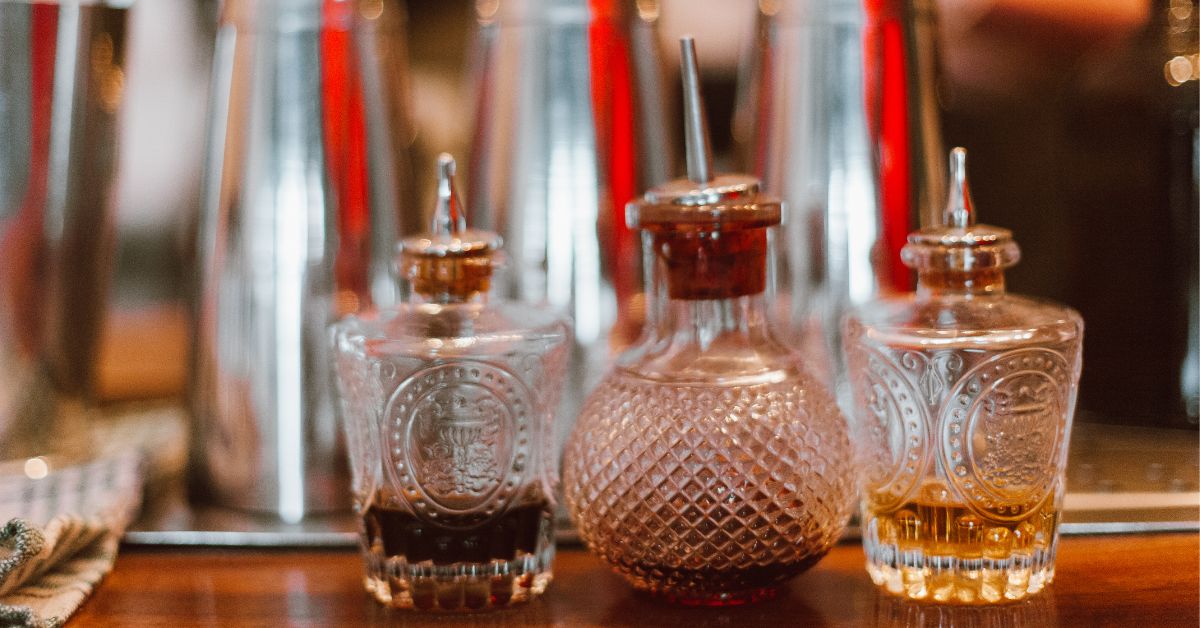

Cocktail bitters are one of the most common ingredients in classic cocktail recipes and one of the least understood. Most people who follow a recipe that calls for “two dashes of Angostura” add them without knowing what they’re actually doing to the drink.
Cocktail bitters are concentrated herbal extracts made by infusing botanicals, herbs, spices, roots, bark, and citrus peels, into high-proof alcohol. Used in small amounts, typically two to three dashes, they add aromatic complexity, depth, and structure to a cocktail without contributing noticeable flavor of their own. They’re not there to taste like anything in particular. They’re there to make everything else taste better.
This guide covers what bitters are, where they came from, the most common types, and how to use them correctly.

Bitters weren’t invented for cocktails. In the early 1800s, they were sold as medicinal tonics, concentrated botanical extracts believed to support digestion, settle the stomach, and treat a range of ailments. Angostura bitters, still the most widely used aromatic bitters today, were created in 1824 by a German physician named Johann Gottlieb Benjamin Siegert while serving as Surgeon General in Venezuela. He named them after the town of Angostura, now called Ciudad Bolívar.
Their migration from medicine cabinet to bar happened gradually. By 1806, one of the earliest published definitions of a “cocktail” already included bitters alongside spirit, sugar, and water, the same four-element structure that became the Old Fashioned. As cocktail culture developed through the 19th century, bitters became a standard tool behind the bar, less for their supposed medicinal properties and more for what they did to a drink’s flavor.
Today, cocktail bitters are available in a wide range of styles. Classic options like aromatic and orange bitters remain the most widely used, but more modern variations include flavors like chocolate, coffee, lavender, and even walnut. Each one brings a slightly different character, but the role stays the same.
The bottles look different and there are far more varieties today, but bitters still serve the same function they did in 1824.
Most cocktail recipes call for just a few dashes of bitters, often two or three at most, It’s easy to assume they’re a minor detail.
In a spirit-forward cocktail, though, bitters do real structural work. They add aromatic complexity, a dry, herbal, spiced layer that gives the drink depth without contributing a flavor that competes with the spirit. The sweetness from the syrup feels more refined with bitters present. The whiskey feels more integrated. The finish lingers longer and feels more complete.
The clearest way to understand what bitters contribute is to make the same cocktail without them. An Old Fashioned without bitters is sweetened whiskey, not bad, but one-dimensional. With two dashes of Angostura, it becomes a cocktail. The bitters don’t announce themselves, but their absence is immediately noticeable.
That’s what makes them easy to underestimate. They work quietly, shaping the drink from the background rather than the foreground.

| Bitters | Flavor Profile | Classic Use Cases |
|---|---|---|
| Angostura Aromatic | Clove, cinnamon, spice, herbal | Old Fashioned, Manhattan, Champagne cocktail |
| Peychaud’s Aromatic | Lighter, floral, anise-forward | Sazerac, Vieux Carré |
| Orange Bitters | Bright citrus, slightly bitter | Martini, Manhattan, Negroni |
| Mole / Chocolate Bitters | Dark chocolate, spice | Mezcal cocktails, dark spirit builds |
| Cardamom Bitters | Floral, slightly sweet spice | Modern builds, gin cocktails |
| Coffee Bitters | Roasted, slightly bitter | Espresso Martini variations, whiskey cocktails |
Angostura is the default, the bitters most recipes mean when they just say “bitters.” Its flavor is complex and warm: clove-forward, with cinnamon, gentian root, and a range of other botanicals that give it a distinct spiced character. In an Old Fashioned or Manhattan, it adds depth and a dry finish that pulls the drink together.
The bottle is recognizable by its oversized paper label, which is intentional, legend holds that when the Siegert brothers entered Angostura into a competition in 1862, they forgot to source a properly sized label and used what they had. They won the competition, and the oversized label became part of the brand identity.
Peychaud’s is lighter and more floral than Angostura, with a prominent anise note. It’s the bitters of choice for a Sazerac and plays a key role in several New Orleans classics. In an Old Fashioned, some bartenders use a combination of Angostura and Peychaud’s — the Angostura for structure, the Peychaud’s for a floral lift.
Orange bitters were actually more common than aromatic bitters in the late 19th century before largely disappearing for most of the 20th. They’ve since come back into wide use. Regans’ Orange Bitters No. 6 and Fee Brothers West Indian Orange Bitters are two of the most common. In a Manhattan or a Martini, orange bitters add a bright citrus note that lifts the drink without adding sweetness.
The standard for most cocktail recipes is 2 dashes. A dash from a dasher-top bottle is roughly 0.6 ml, so two dashes amounts to just over a milliliter. That’s intentionally small, bitters at full concentration are intensely flavored, and the goal is influence, not presence.
Starting with 2 dashes and adjusting from there is the right approach. Some drinkers prefer 3 dashes of Angostura in an Old Fashioned for a slightly more pronounced spice note. Going beyond that tends to tip the drink into bitterness that competes with the spirit.

In a built cocktail like an Old Fashioned, bitters go in first, before the sweetener and before the whiskey. Adding them directly to the glass lets them coat the bottom before the other ingredients are poured over, which helps them distribute evenly through the drink during stirring.
In shaken cocktails, the order matters less since shaking distributes everything evenly. But bitters are still added before the ice, along with the other ingredients.
Bitters have a very high alcohol content, typically 35–45% ABV, which acts as a natural preservative. An opened bottle keeps essentially indefinitely at room temperature, away from direct sunlight. There’s no need to refrigerate them.
Bitters appear in a wide range of classic cocktails, but they’re most prominent (and most important) in spirit-forward drinks with minimal ingredients. The Old Fashioned, Manhattan, Sazerac, and Vieux Carré all depend on bitters to provide the aromatic structure that keeps the drink from feeling flat.
In longer, more citrus-driven cocktails, a Gin & Tonic, a Mojito, a Daiquiri, bitters are sometimes used, but they’re less essential. The citrus and other ingredients provide enough complexity on their own that bitters become more of a finishing touch than a structural element.
The principle is similar to demerara syrup: the simpler and more spirit-forward the cocktail, the more noticeable and important the bitters become.
On their own, bitters taste intensely herbal, bitter, and aromatic, they’re not pleasant to drink straight. But in a cocktail at 2 dashes, that intensity translates to depth and complexity rather than bitterness. Angostura specifically tastes of clove, cinnamon, and warm spice. Orange bitters taste of concentrated citrus peel with a dry finish.
Yes. Most cocktail bitters are 35–45% ABV, similar to many spirits. Because only a few dashes are used per drink, the amount of alcohol they contribute is negligible — roughly equivalent to adding a few drops of water.
Angostura is heavier and more complex, with a prominent clove and spice character. Peychaud’s is lighter and more floral, with a noticeable anise note. Angostura is the more versatile of the two and works in a wider range of cocktails. Peychaud’s is particularly associated with New Orleans classics like the Sazerac.
Technically yes, but it changes the drink significantly. Without bitters, an Old Fashioned is sweetened whiskey with a citrus garnish — it lacks the aromatic structure and dry finish that bitters provide. Most bartenders would consider the result incomplete. The bitters are part of what makes it a cocktail rather than just a sweetened spirit.
They overlap but aren’t identical. Cocktail bitters and digestive bitters (like Campari or Aperol) are both botanical extracts, but digestive bitters are meant to be consumed in larger amounts, as an aperitif or digestif, and are significantly less concentrated. Cocktail bitters are used only a few dashes at a time because of how concentrated they are.
Bitters are the smallest ingredient in most cocktail recipes and the easiest to underestimate. Two dashes doesn’t look like much. But in a spirit-forward drink with four ingredients, that small amount does real work, adding the aromatic complexity and dry structure that keeps the drink from falling flat.
The Mixologer’s Old Fashioned cocktail kits include Angostura bitters pre-measured alongside the whiskey and demerara syrup, so every element is already in the right proportion. The structure is built in from the start.